How to Write a Book Subtitle That Helps Readers Find Your Book
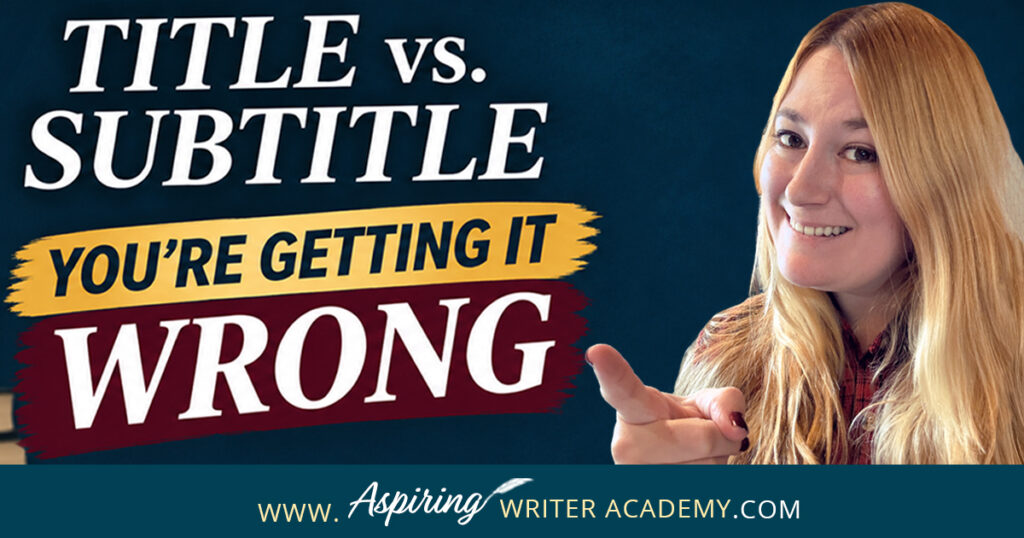
Your book title might grab a reader's attention, but your subtitle could be what convinces them to take a closer look. More importantly, it can help readers discover your book in the first place.
If you've spent hours brainstorming the perfect title for your novel, don't overlook the importance of your subtitle. A well-written subtitle gives you another opportunity to incorporate relevant keywords, communicate what your book is about, and help potential readers understand exactly what they're getting.
Think about it. You might have a beautiful, creative, or intriguing title, but does it actually tell readers what genre your book belongs to? Does it communicate the setting, themes, or type of reading experience they can expect? And does it include any of the descriptive phrases readers might be searching for on Amazon?
Probably not. And that's where your subtitle can make a difference.
In this blog post we'll explore why book subtitles matter, how to choose the right keywords, and how to write a subtitle that complements your main title while helping readers discover your book.
Watch the video below for more tips and examples!

Why Are Book Subtitles Important?
One of the biggest mistakes authors make is putting all their attention into the main title while giving very little thought to the subtitle.
Your main title doesn't necessarily have to communicate everything about your book. In fact, many authors choose creative, artistic, or intriguing titles that capture the imagination without necessarily explaining what the story is about.
That's perfectly fine!
Your subtitle gives you another opportunity to communicate those details.
Think of your main title as the creative hook and your subtitle as the descriptive marketing tool. Together, they can help readers understand what your book offers and whether it's something they'd enjoy.
A well-written subtitle can help:
- Communicate your genre: Let readers know whether they're looking at a romance, mystery, fantasy, thriller, or another type of book.
- Incorporate relevant keywords: Include descriptive words and phrases that readers might use when searching for their next book.
- Highlight your setting and themes: Give readers a better idea of where your story takes place and what they can expect.
- Set reader expectations: Communicate important details about the story, including its format or length when relevant.
- Attract your ideal audience: Help your book appeal to readers who already enjoy the type of story you're writing.
Your subtitle is essentially another opportunity to market your book, so it's worth putting just as much thought into it as you do your main title.
Your Main Title Can Be Creative, Your Subtitle Can Be Strategic
One of my favorite approaches to book titles is pairing a creative main title with a more descriptive subtitle.
You don't have to sacrifice an interesting or beautiful title just to include the keywords readers are searching for.
For example, imagine you have a historical romance novel called Golden Horizons.
It's an intriguing title, but if someone is browsing Amazon for historical Christian romance novels set during the California Gold Rush, the words Golden Horizons alone don't communicate much about the story.
Someone who has never heard of your book probably isn't going to search for that exact title.
However, adding a descriptive subtitle changes things.
or example:
Golden Horizons: A California Gold Rush Christian Historical Romance Novella
Now readers have a much better idea of what they're getting.
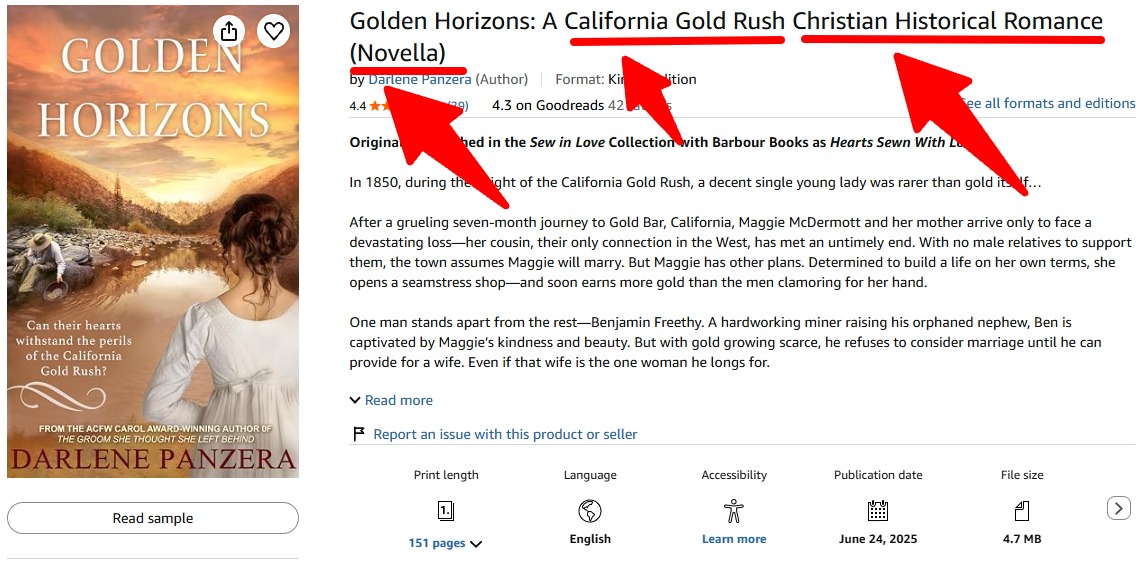
The subtitle communicates:
- California Gold Rush: Establishes the historical setting and time period.
- Christian: Identifies the faith element of the story.
- Historical Romance: Clearly communicates the genre.
- Novella: Sets expectations about the length and format of the book.
Instead of relying entirely on a creative title, you're giving readers several descriptive clues that help them identify whether your book is something they'd enjoy.
This is especially important for self-published authors who are responsible for positioning and marketing their own books.
And here's something else worth remembering: Your subtitle doesn't always have to appear prominently on your physical book cover. Depending on your publishing and design choices, you might use your creative main title on the cover while including the full subtitle in your Amazon, Barnes & Noble, and other online book listings.
This gives you some flexibility to maintain a clean, attractive cover design while still taking advantage of the descriptive information a subtitle provides.
Examples of Effective Book Titles and Subtitles
Let's look at a few examples from my mom, Darlene Panzera's, books. These are particularly helpful because we learned firsthand how important descriptive wording can be when she was traditionally publishing with Avon Books.
When brainstorming titles, they encouraged using words that gave readers clues about the story. Words like love, marry, cowboy, and wrangler could help communicate the genre, characters, and setting without making the main title overly long.
Here are a few examples.
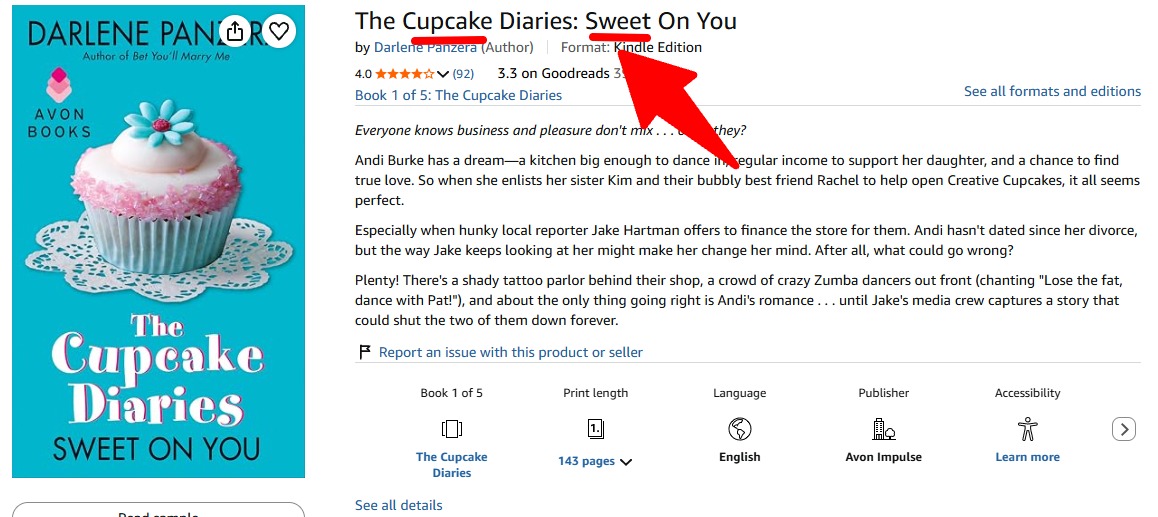
1. Sweet on You
Sweet on You is the first book in The Cupcake Diaries series.
The word sweet provides an immediate clue about the tone of the story. It suggests a lighthearted, feel-good reading experience rather than something dark, gritty, or suspenseful.
Although it is a simple word, it helps establish the type of story readers can expect.
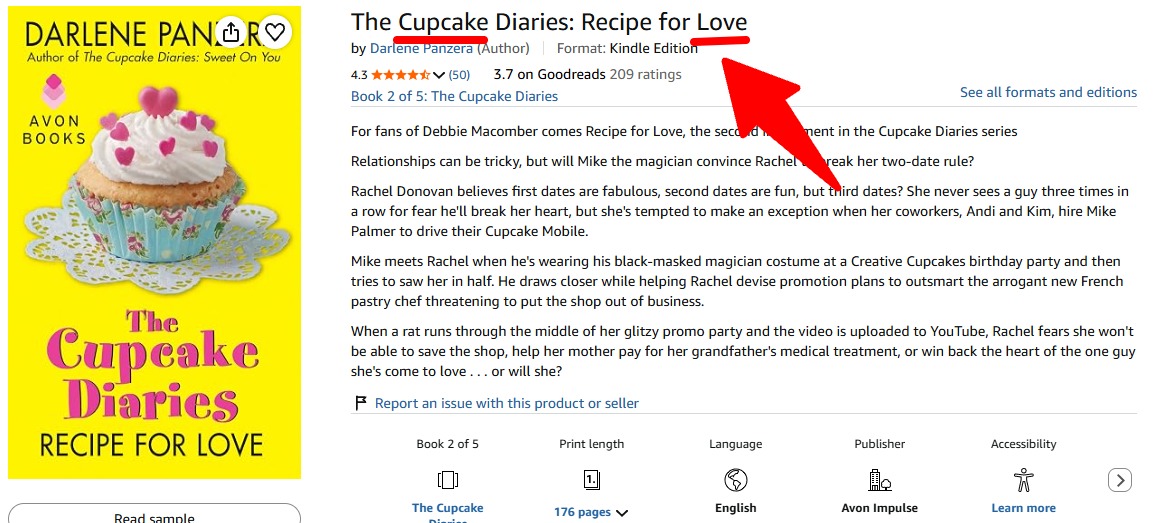
2. Recipe for Love
Another book in The Cupcake Diaries series is Recipe for Love.
Here, the word love immediately signals a romance element. It gives readers a general idea of the genre before they even read the book description.
These examples demonstrate how carefully selected words can communicate the tone and reading experience of a story.
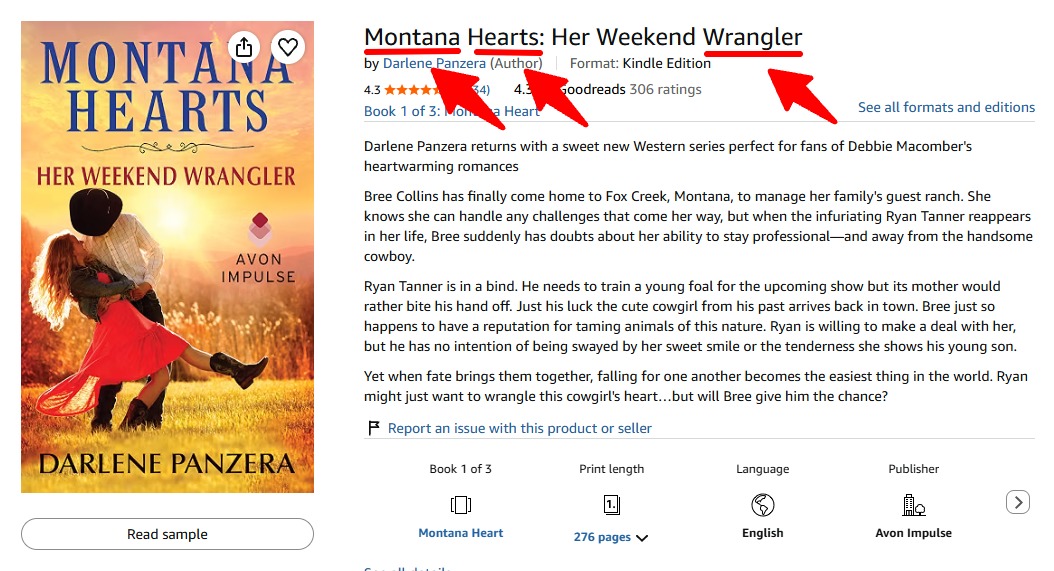
3. Montana Hearts: Her Weekend Wrangler
Now let's look at another series, Montana Hearts.
The title Her Weekend Wrangler uses several descriptive words that help establish the story's setting and genre.
- Montana: Communicates the geographical setting.
- Hearts: Suggests a romantic storyline.
- Wrangler: Brings to mind cowboys, ranch life, and a Western setting.
Before reading the book description, potential readers already have a general understanding of the type of story they are considering.
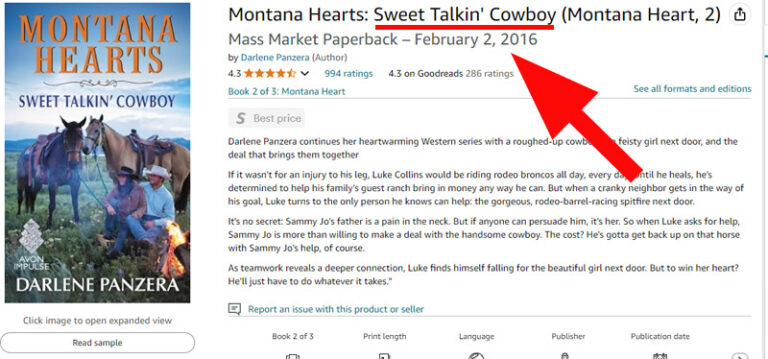
4. Montana Hearts: Sweet Talking Cowboy
Another book in the series is Sweet Talking Cowboy.
Once again, the word choices are intentional.
- Montana: Reinforces the setting.
- Hearts: Communicates the romance element.
- Sweet: Suggests the tone of the romance.
- Cowboy: Establishes something about the male lead and Western setting.
Together, these words help position the book for readers who enjoy sweet Western romances and cowboy love stories.
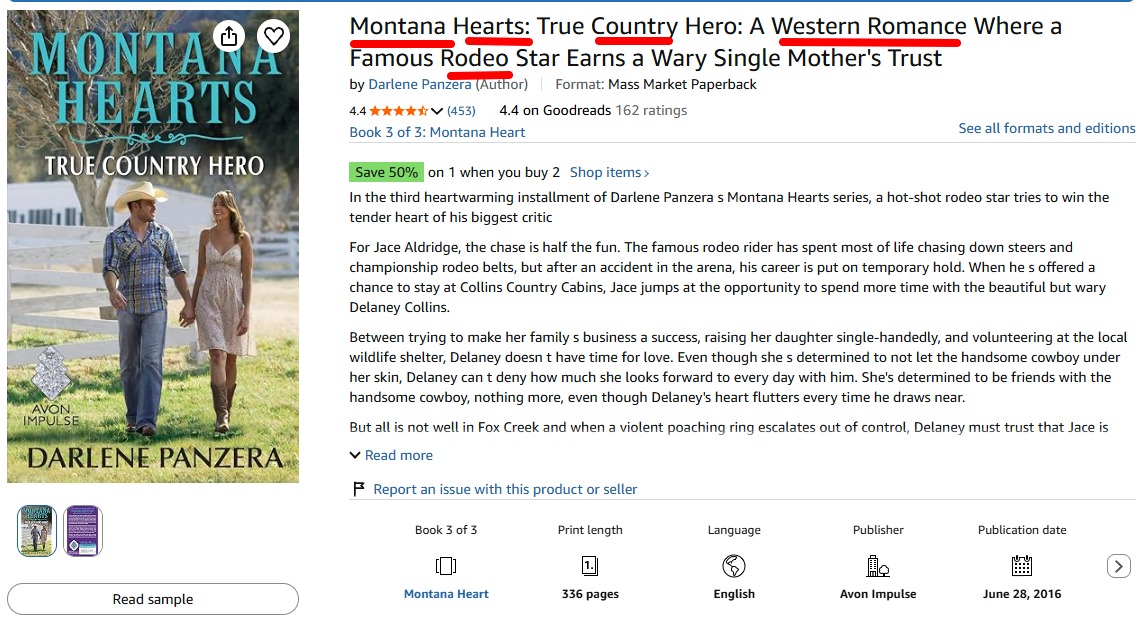
5. Montana Hearts: True Country Hero
For True Country Hero, Avon Books also incorporated a longer descriptive phrase into the Amazon book listing:
A Western romance where a famous rodeo star earns a wary single mother's trust.
This additional wording provides even more information about the story.
- Western romance: Identifies the genre.
- Rodeo star: Introduces an important detail about the male lead.
- Single mother: Gives readers insight into the female lead and an important character dynamic.
- Trust: Hints at one of the central relationship themes.
This is an excellent example of how descriptive language can communicate what makes a particular story interesting.
The main title captures attention, while the additional wording helps readers understand the story and decide whether it appeals to them.
Using Your Subtitle to Incorporate Search Keywords
One of the biggest advantages of a descriptive subtitle is the opportunity to include keywords that might not naturally fit into your main title.
Consider how often readers search for books using descriptive phrases rather than specific book titles.
Someone looking for their next read might search for:
- Sweet romance
- Clean romance
- Christian historical romance
- Small-town romance
- Regency romance
- Victorian romance
- Cowboy romance
- Enemies-to-lovers romance
- Friends-to-lovers romance
- Cozy mystery
- Psychological thriller
- Murder mystery
- Romantic suspense
- Epic fantasy
- High fantasy
- Dark fantasy
- Paranormal romance
- Dystopian fiction
These descriptive phrases help readers narrow down their options and find books that match their interests.
Your subtitle provides another opportunity to incorporate some of these terms naturally.
For example, Darlene Panzera's book Golden Horizons.
Its subtitle, A California Gold Rush Christian Historical Romance Novella, communicates several important details about the story while incorporating descriptive search terms.
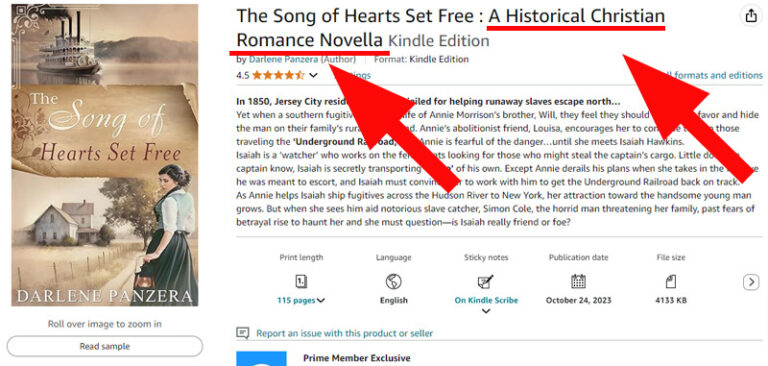
The same approach applies to another of her books, The Song of Hearts Set Free, which uses the subtitle A Historical Christian Romance Novella.
Once again, the main title is creative and intriguing, while the subtitle communicates the genre, faith element, and format.
A reader who has never heard of either book might not know to search for its creative title. However, descriptive phrases such as historical Christian romance give readers a much clearer idea of what they might enjoy.
The main title captures attention and imagination. The subtitle helps readers understand what the book offers and discover it through relevant search terms.
How to Choose the Right Keywords for Your Book Subtitle
Once you understand the importance of descriptive keywords, the next step is identifying which ones are most relevant to your particular story.
You do not need to include every possible keyword. Instead, focus on a handful of descriptive terms that accurately represent your book and appeal to your intended audience.
Here are four areas to consider when brainstorming.
1. Identify Your Book's Genre
Start by identifying the primary genre of your book.
Is it a historical romance, contemporary romance, fantasy novel, mystery, or thriller?
Your genre is one of the most important details you can communicate to potential readers. Including a clear genre description helps readers quickly determine whether your book fits their interests.
You can also consider whether your book belongs to a more specific subgenre.
For example:
- Historical romance
- Regency romance
- Victorian romance
- Western romance
- Small-town romance
- Romantic suspense
- Cozy mystery
- Psychological thriller
- Epic fantasy
- Paranormal romance
The more accurately you can describe your book, the easier it becomes for readers to understand where it fits within the market.
2. Consider Your Setting
Where does your story take place?
Setting can be an important selling point, particularly when it distinguishes your book from other stories in the same genre.
Consider whether your book takes place:
- In a small town or rural community.
- On a ranch in Montana.
- During the California Gold Rush.
- In Victorian England.
- During World War II.
- In a futuristic dystopian society.
- Around Christmas or another holiday.
If your setting plays an important role in the story, consider incorporating a relevant location, historical period, or descriptive phrase into your subtitle.
For example, A California Gold Rush Christian Historical Romance Novella immediately communicates much more about the story than the main title Golden Horizons alone.
3. Highlight Themes and Story Elements
What makes your story unique?
Think about the characters, relationships, conflicts, and themes that are central to your book.
For romance authors, these might include:
- Enemies to lovers
- Friends to lovers
- Second-chance romance
- Single-parent romance
- Cowboy romance
- Sweet romance
- Clean romance
- Steamy romance
For mystery and thriller authors, consider:
- Murder mystery
- Psychological suspense
- Detective mystery
- Small-town mystery
- Romantic suspense
For fantasy authors, possibilities might include:
- Dragons
- Magic
- Paranormal
- Supernatural
- Dystopian
- Epic adventure
You do not need to incorporate every story element into your subtitle. Focus on the details that best communicate the appeal of your book to its intended audience.
4. Establish the Right Reader Expectations
Your subtitle should accurately represent the book and the reading experience it offers.
For example, if you are publishing a novella rather than a full-length novel, including the word novella can help establish expectations about the book's format and length.
This is an important detail that authors sometimes overlook.
Imagine a reader purchasing a book expecting a 300-page novel, only to discover that the story is actually a much shorter novella. Even if the story itself is excellent, the difference in expectations could lead to disappointment.
A descriptive subtitle helps prevent this type of confusion.
The same principle applies to genre and tone. If you are writing a sweet, wholesome romance, your subtitle should communicate that rather than suggesting a steamy romance.
Accurate descriptions help attract readers who are more likely to enjoy your book.
How to Research Keywords for Your Book Subtitle
After brainstorming the elements that make your book unique, spend some time researching the language readers are using to discover books.
You do not have to rely entirely on guesswork. There are several simple ways to identify relevant search phrases and learn how other authors position their books.
1. Use Amazon Search Suggestions
One of the easiest places to begin your keyword research is Amazon.
Visit Amazon and start typing phrases related to your book into the search bar. Pay attention to the autocomplete suggestions that appear as you type.
For example, if you are writing a historical romance, try entering phrases such as:
- Historical romance
- Christian historical romance
- Regency romance
- Western romance
- Sweet cowboy romance
Notice which additional phrases appear in the suggestions.
These can provide ideas about the types of searches readers may be conducting and introduce descriptive terms you might not have considered.
Make a list of relevant suggestions and look for patterns. Are certain genres or descriptive phrases appearing repeatedly? Are there particular themes or story elements that seem closely related to your book?
Use these observations as a starting point for brainstorming.
Keep in mind that Amazon autocomplete suggestions are research clues, not a guarantee of search volume or sales potential. The most important consideration is whether a keyword accurately describes your book.
2. Research Successful Books in Your Genre
Another useful strategy is examining books that are similar to yours.
Find successful books within your genre, particularly those that appeal to the same audience you are hoping to reach.
Pay attention to:
- The descriptive words authors use in their titles and subtitles.
- How they communicate the genre.
- Whether they highlight a particular setting or historical period.
- How they describe the tone or themes of the story.
- Which phrases appear frequently across similar books.
For example, if you are writing a sweet Western romance, examine other books in that category.
You might notice that authors frequently use terms such as cowboy, ranch, Western romance, and small-town romance.
This research can help you identify the language readers are familiar with and the types of descriptions commonly associated with your genre.
The goal is not to copy another author's subtitle. Instead, use these examples to understand how similar books are positioned and develop wording that accurately represents your own story.
3. Think Like Your Ideal Reader
One of the most helpful questions you can ask yourself is:
If someone had never heard of my book, what words would they type into Amazon to find a story like mine?
Try putting yourself in the reader's position.
Would they search for a clean historical romance? A cozy mystery set in a small town? A fantasy novel featuring dragons? A Christian romance set during the Victorian era?
Think about the specific audience you want to reach and the language those readers might use when searching for their next book.
This exercise can help you move beyond the creative title you have chosen and identify descriptive phrases that communicate the actual reading experience.
Common Book Subtitle Mistakes to Avoid
Once you have brainstormed several possibilities, take some time to review your options. There are a few common mistakes that can make a subtitle less effective.
1. Being Too Vague
Your subtitle should provide useful information about your book.
If your main title is already abstract or artistic, adding another vague phrase may leave readers with very little understanding of the story.
For example, a subtitle such as A Story of Love and Adventure sounds appealing, but it does not communicate much about the genre, setting, or specific elements of the story.
Consider whether you can replace general wording with more descriptive terms that help readers understand what makes your book unique.
2. Keyword Stuffing
On the opposite end of the spectrum, some authors try to include every possible keyword they can think of.
This can result in long, awkward subtitles that feel more like a collection of search terms than a natural description of the book.
Including too many keywords can make your subtitle feel cluttered and difficult to understand.
Instead, focus on selecting a few highly relevant terms that accurately represent your book. Your subtitle should communicate valuable information to readers while remaining clear, concise, and easy to understand.
3. Using Misleading Keywords
Just because a keyword is popular does not mean it belongs in your subtitle.
For example, if you are writing a clean romance, using terms associated with steamy romance simply because you believe they might attract more readers could create the wrong expectations.
Similarly, a cozy mystery should not be marketed as a psychological thriller if that is not an accurate description of the story.
Misleading keywords may attract the wrong audience and leave readers disappointed when the book does not match their expectations.
The objective is to attract the right readers, not simply generate more clicks.
4. Overlooking Your Book Cover Design
Your subtitle should complement your main title, cover design, and book description.
If you plan to include the subtitle on your physical cover, consider how readable it will be when someone views the book as a small thumbnail image online.
A lengthy subtitle can sometimes overwhelm the main title or make the cover appear cluttered.
Think about the overall presentation and whether your subtitle works visually as well as descriptively.
Remember that your online book listing can provide additional descriptive information, even when your cover design uses a shorter presentation.
Checklist for Writing Your Book Subtitle
Before settling on a final subtitle, take a few minutes to brainstorm different possibilities.
Use the following questions to help evaluate your ideas.
About your book:
- What is the primary genre?
- Does the book belong to a specific subgenre?
- Where does the story take place?
- What time period is it set in?
- What are the central themes?
- What makes the story unique?
- Who is the ideal reader?
About your keywords:
- What words would readers use to search for a book like yours?
- What phrases appear in Amazon autocomplete suggestions?
- What keywords are other successful authors in your genre using?
- Which descriptive terms communicate the story most effectively?
About your final subtitle:
- Does it accurately represent the book?
- Does it clearly communicate the genre?
- Does it complement the main title?
- Does it help readers understand what they are getting?
- Is it clear, concise, and easy to read?
- Does it establish the right expectations?
Try writing several different versions before choosing your favorite. Sometimes a small change in wording can make a significant difference in how clearly your subtitle communicates the story.
You can also revisit books you have already published. If an older book has a creative main title but no descriptive subtitle, consider whether adding one could improve the way your book is presented to potential readers.
Final Thoughts: Give Your Book Subtitle the Attention It Deserves
Your main title can capture a reader's imagination, but your subtitle provides another opportunity to communicate what your book is about.
By incorporating relevant keywords, highlighting your genre and setting, and accurately describing the reading experience, you can make your book listing more informative and appealing to potential readers.
A successful subtitle does not need to be complicated or overloaded with keywords. It simply needs to work alongside your main title to communicate the value of your book and help the right readers discover it.
Take some time to brainstorm different options, research relevant search terms, and consider what your ideal reader might be looking for. You may even discover opportunities to improve the subtitles on books you have already published.
A little extra thought can go a long way toward making your book more discoverable.
We Believe All Authors Can Aspire to Take Their Writing to the Next Level!
Our Goal for Aspiring Writer Academy is to help people learn how to write quality fiction, teach them to publish and promote their work, and to give them the necessary tools to pursue a writing career.
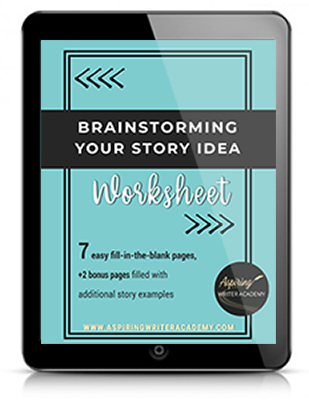
Before You Go… Grab This Free Resource!
If you’re in the early stages of writing your novel, don’t forget to download our free Brainstorming Your Story Idea Worksheet. It includes:
-
Fill-in-the-blank prompts
-
Story structure examples
-
Guided questions
-
Idea-boosting templates
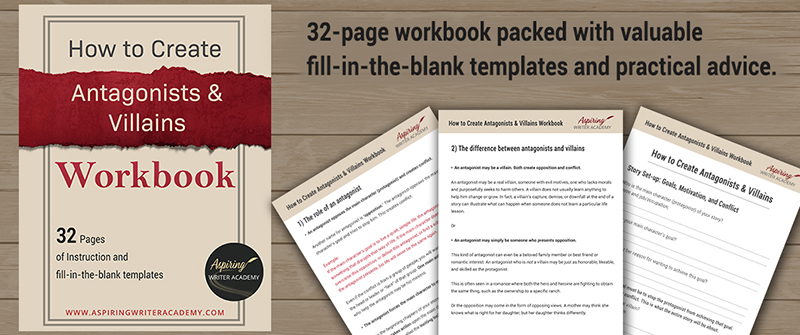
Do you find it difficult to create compelling antagonists and villains for your stories? Do your villains feel cartoonish and unbelievable? Do they lack motivation or a specific game plan? Discover the secrets to crafting villains that will stick with your readers long after they finish your story, with our How to Create Antagonists & Villains Workbook.
This 32-page instructional workbook is packed with valuable fill-in-the-blank templates and practical advice to help you create memorable and effective antagonists and villains. Whether you're a seasoned writer or just starting out, this workbook will take your writing to the next level.
Other Posts You May Like: