How to Plot a Novel Using the W Plot Structure (An Easy Template for New Writers)
Do you have a great story idea but struggle to figure out what happens next?
Plotting a novel can feel overwhelming, especially when you are staring at dozens of ideas and trying to figure out how they all fit together. Fortunately, you don't have to plan every scene before you begin writing.
The W Plot is a simple story structure that can help you organize the major events of your novel while still giving you plenty of freedom to create.
This easy-to-follow plotting method breaks your story into five major turning points that guide your protagonist from the beginning of the story to the climax and resolution.
Watch the Video: How to Plot a Novel Using the W Plot
Want to see how the W Plot works visually?
▶ Click here to watch the video: How to Plot a Novel Using the W Plot Structure
In this video, Darlene Panzera walks through each point of the W Plot and explains how you can use this flexible structure to take the frustration out of plotting your novel.
What Is the W Plot?
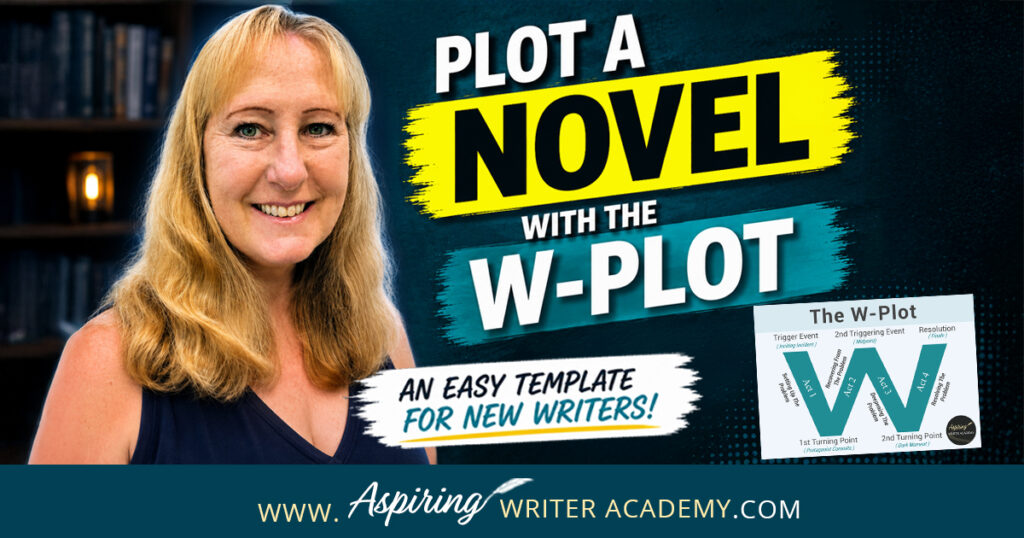
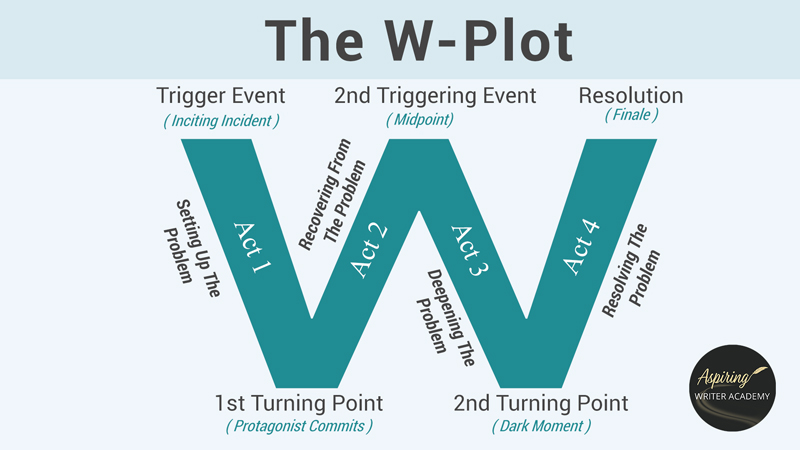
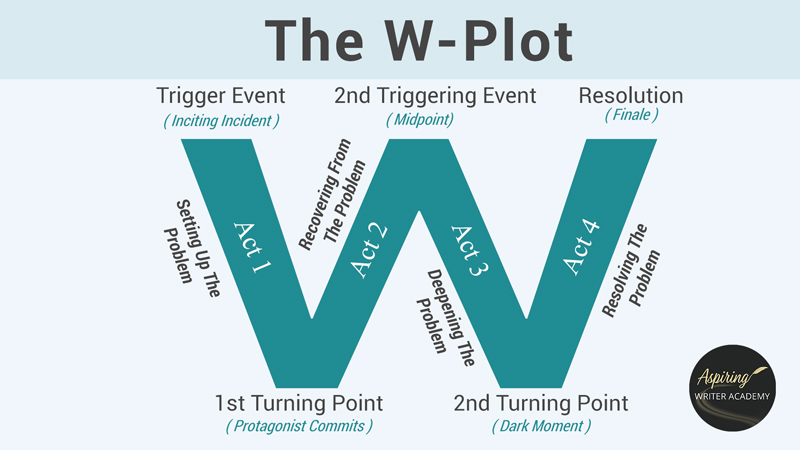
The W Plot is a four-act story structure named for the shape the major events of the story create when plotted on a graph.
Unlike the traditional three-act structure, the W Plot divides the middle of the story into two sections. This creates four acts:
- Act One: The beginning of the story
- Act Two: The first half of the middle
- Act Three: The second half of the middle
- Act Four: The ending
The structure includes five major story points that help guide your protagonist through the story.
Think of these five points as the bare bones of your novel. You don't need to know every scene, conversation, or detail yet. Instead, you can identify the major events that move your character from one stage of the story to the next.
This makes the W Plot especially useful for new writers who may feel overwhelmed by the idea of plotting an entire novel.
Why Use the W Plot to Structure Your Novel?
Writing a novel is a huge project. One way to make a large project feel more manageable is to break it into smaller pieces.
Instead of asking:
"What happens in my entire novel?"
you can ask:
"What major event happens at each point of my story?"
The W Plot gives you a roadmap without requiring you to know everything in advance.
It can help you:
- Organize the major events of your story
- Keep your plot moving forward
- Give your protagonist a clear goal
- Create rising and falling tension
- Strengthen the middle of your novel
- Avoid unnecessary tangents
- Build toward a stronger climax
- See how one major event leads to the next
The W Plot is also flexible. You can use it as a detailed outline or simply as a loose framework to guide you while you write.
Is the W Plot Good for Pantsers?
Absolutely!
A pantser is a writer who prefers to write "by the seat of their pants" rather than extensively outlining a novel before beginning.
Some writers love detailed outlines. Others find that too much planning takes the fun out of discovering the story.
The W Plot can work for both.
If you're a pantser, you don't have to plan your entire book. You can simply identify the five major story points and leave everything between them open for discovery.
For example, you could write each major event on a sticky note and arrange the notes in the shape of a W.
As you develop your story, you can add ideas, scenes, characters, and complications between those major points.
The goal isn't to eliminate creativity.
The goal is to give your creativity somewhere to go.
The 5 Points of the W Plot
The W Plot contains five major story points. Let's take a closer look at each one.
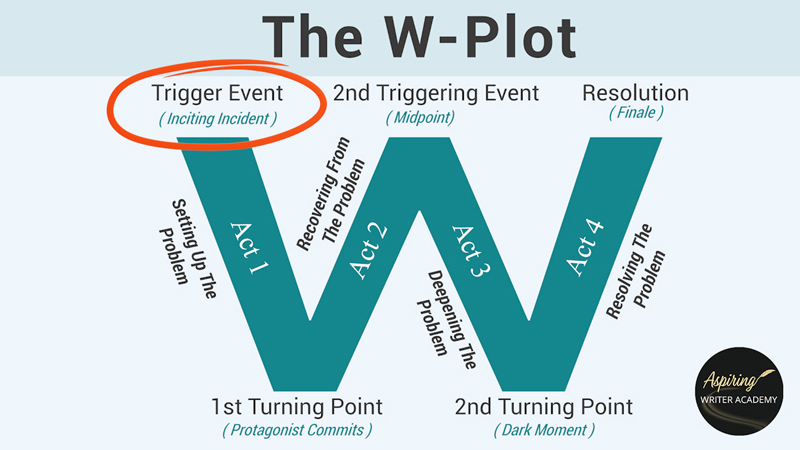
1. Trigger Event (Inciting Incident)
The first point of the W Plot is the trigger event, also known as the inciting incident.
At the beginning of your novel, your protagonist is living in their ordinary world. Then something happens that changes everything.
The character is presented with a problem, threat, opportunity, or challenge that they cannot simply ignore.
The trigger event might be:
- An unexpected attack
- A serious threat
- A call to go on a quest
- The arrival of a new enemy
- A shocking discovery
- A major loss
- An unexpected opportunity
- An event that forces the character to take action
Whatever happens, it disrupts your protagonist's ordinary life and starts the story-long journey.
Ask yourself:
What happens that changes my protagonist's life forever?
Your trigger event should create a problem that needs to be solved.
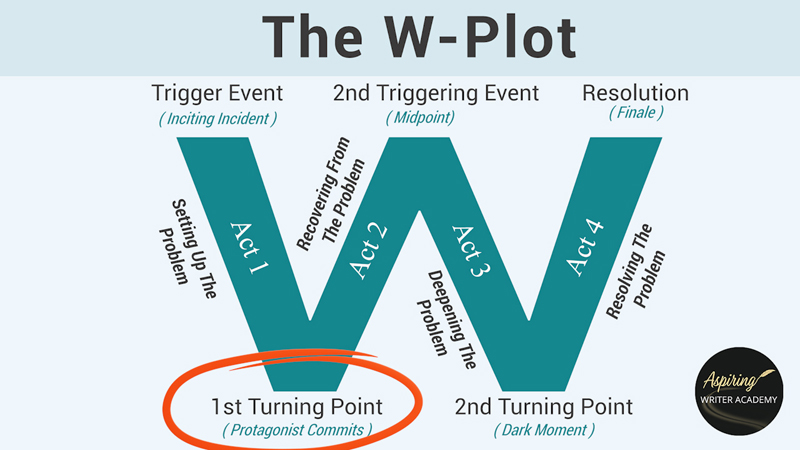
2. First Turning Point
After the trigger event, your protagonist's life begins moving in a downward direction.
They have a problem, but they don't necessarily know what to do about it yet.
The character may weigh the costs and consequences of taking action. They may resist the challenge or try to find another way around it.
Eventually, however, the protagonist must make a decision.
They establish a goal or action plan that will hopefully allow them to overcome the problem.
This decision becomes the first turning point.
The protagonist may:
- Leave their comfortable life behind
- Accept a dangerous challenge
- Begin a journey
- Team up with someone they dislike
- Pursue an important goal
- Decide to confront an opponent
The important thing is that the protagonist's decision changes the direction of the story.
Their life will not be the same after this point.
Ask yourself:
What decision does my protagonist make that commits them to the journey?
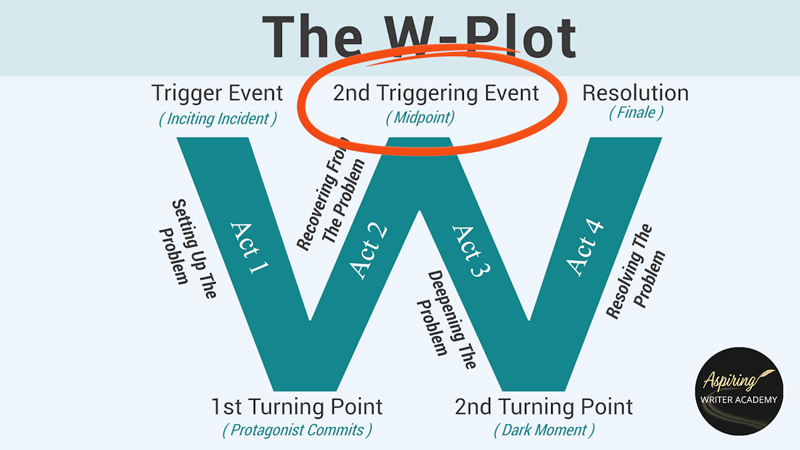
3. Second Triggering Event (Midpoint)
The third point of the W Plot is the second triggering event, which occurs around the midpoint of the novel.
At this stage, your protagonist has generally been moving upward.
They may be:
- Learning new skills
- Gaining knowledge
- Gathering resources
- Making new allies
- Becoming more confident
- Getting closer to achieving their goal
But just when the protagonist believes they may finally be getting somewhere, something happens that changes everything again.
This is a major complication.
For example:
- A mentor dies
- A devastating secret is revealed
- A new enemy appears
- An ally betrays the protagonist
- The original problem becomes much bigger
- The protagonist discovers they misunderstood the situation
- Two former enemies must work together against a greater threat
The second triggering event should deepen and complicate the original problem.
Ask yourself:
What happens at the midpoint that changes everything again?
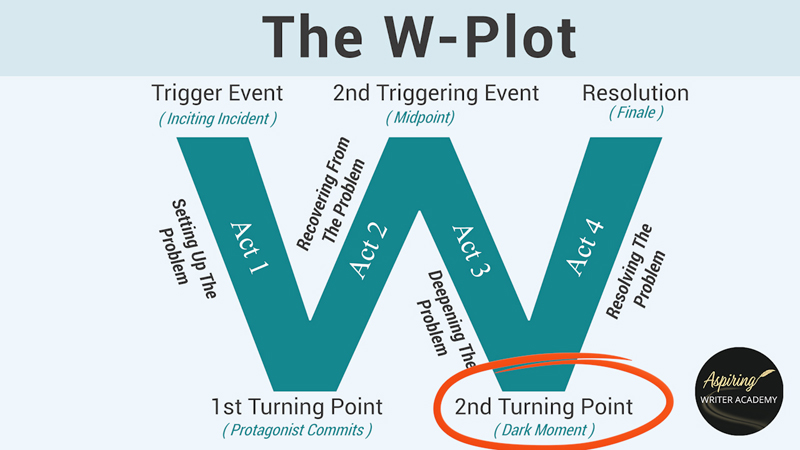
4. Second Turning Point (The Dark Moment)
The fourth point is the second turning point, often called the dark moment.
After the midpoint complication, your protagonist's situation begins to deteriorate.
The opposition seems to gain the upper hand, and everything the protagonist has worked toward may begin falling apart.
Allies may disappear.
Characters may betray one another.
False information may lead the protagonist in the wrong direction.
The antagonist may launch a devastating attack.
The protagonist may lose something important.
Eventually, your main character reaches a point where they believe all is lost.
They cannot see a way forward.
This is the lowest point of the story—the dark moment of the soul.
Ask yourself:
What happens that makes my protagonist believe they have lost?
The darker this moment feels, the more satisfying it can be when the protagonist finds a way to move forward.
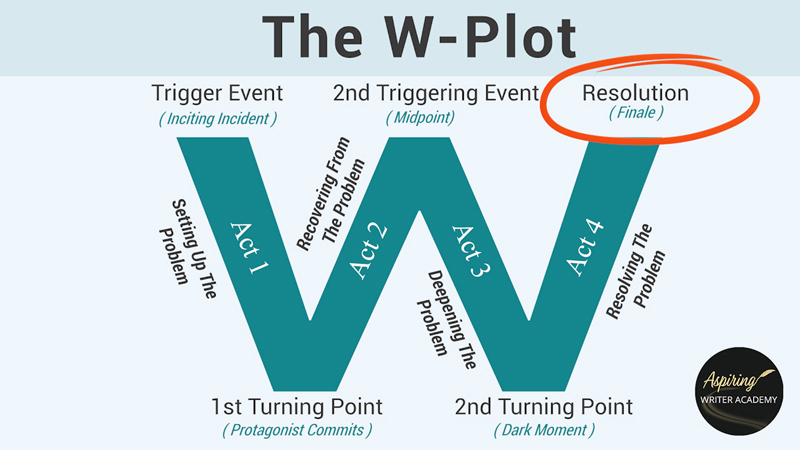
5. Resolution
Finally, we reach the resolution.
This is where the story reaches its climax and the major story problem is resolved.
Often, the protagonist faces the opposition directly in a final confrontation.
The protagonist may:
- Defeat the antagonist
- Achieve their goal
- Save someone
- Solve the central problem
- Fail to achieve their goal
- Make a sacrifice
- Discover that what they wanted wasn't what they truly needed
In many stories, the protagonist gains some new information, insight, or understanding shortly before the resolution.
That discovery helps lift them out of the dark moment and motivates them to make one final attempt.
They draw on everything they have learned throughout the story—their new skills, knowledge, resources, and relationships—to face the final challenge.
Ultimately, the protagonist either achieves the story goal or fails.
Either outcome can work, depending on the story you want to tell.
Ask yourself:
How will my protagonist finally confront the central problem?
How to Use the W Plot to Plan Your Novel
You don't need to write a detailed outline to use the W Plot.
Start with the five major points.
Write each one on a sticky note, index card, or piece of paper.
Then arrange them in the shape of a W:
1. Trigger Event → 2. First Turning Point → 3. Midpoint → 4. Dark Moment → 5. Resolution
For each point, write down the major event you think might happen.
You can use words, short descriptions, or even pictures.
Once you can see the five points together, look at the connections between them.
Ask:
How does one point lead to the next?
If the protagonist experiences the trigger event, how does that event lead to the first turning point?
How does the first turning point eventually lead to the midpoint?
How does the midpoint complication create the dark moment?
And how does the dark moment force the protagonist toward the final confrontation?
This exercise can help you identify gaps in your plot before you spend weeks writing scenes that may not move the story forward.
The W Plot Gives You Direction Without Taking Away Your Creativity
One of the biggest advantages of the W Plot is that it gives you a direction without requiring you to know everything.
You can know where your story begins, where it takes major turns, and where it ends while still discovering the details along the way.
That's especially helpful if you're a new writer or a writer who doesn't enjoy creating a detailed outline.
Think of the W Plot as a roadmap.
A roadmap tells you where you're going, but it doesn't tell you exactly what you'll see along every mile of the journey.
Your five major story points are your destinations.
The scenes, characters, dialogue, discoveries, conflicts, and surprises you create along the way are the journey.
Five Story Points to Get Your Novel Moving
You don't have to figure out every detail of your novel before you begin writing.
Start with these five questions:
1. Trigger Event: What changes my protagonist's ordinary life?
2. First Turning Point: What decision commits my protagonist to the journey?
3. Midpoint: What happens that makes the original problem more complicated?
4. Dark Moment: What makes my protagonist believe all is lost?
5. Resolution: How will my protagonist finally confront the central problem?
If you can answer those five questions, you have the bare bones of your story.
From there, you can begin filling in the scenes and details that connect each major event.
And remember: your outline is not a contract.
If you discover a better idea while writing, change your story.
The purpose of a plotting template isn't to restrict your creativity. It's to help you stay oriented while you create.
Who Created the W Plot?
The W Plot is often credited to writer and teacher Mary Carol Moore, who has discussed using the W shape as a way to storyboard fictional stories.
The W Plot has also been taught in writing workshops by other writing instructors and authors, including Karen K. L. Doctor.
Regardless of how you use the method, the basic idea is simple: identify the major highs and lows of your protagonist's journey so you can see the overall direction of your story.
Ready to Start Plotting?
If you've been staring at a blank page wondering how to turn your story idea into a complete novel, try starting with the five points of the W Plot.
You don't need to know every scene.
You don't need to know every chapter.
You don't even need to know every detail of the ending yet.
Start with the major events.
Then ask yourself how each event leads to the next.
Writing is more fun when you know which direction your story is headed.
We Believe All Authors Can Aspire to Take Their Writing to the Next Level!
Our Goal for Aspiring Writer Academy is to help people learn how to write quality fiction, teach them to publish and promote their work, and to give them the necessary tools to pursue a writing career.
Download Our Free Brainstorming Your Story Idea Worksheet
Need help developing your story idea?
If you’re in the early stages of writing your novel, don’t forget to download our free Brainstorming Your Story Idea Worksheet. It includes:
-
Fill-in-the-blank prompts
-
Story structure examples
-
Guided questions
-
Idea-boosting templates
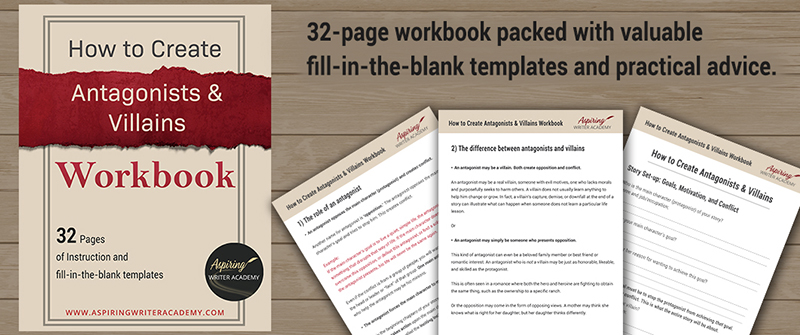
Do you find it difficult to create compelling antagonists and villains for your stories? Do your villains feel cartoonish and unbelievable? Do they lack motivation or a specific game plan? Discover the secrets to crafting villains that will stick with your readers long after they finish your story, with our How to Create Antagonists & Villains Workbook.
This 32-page instructional workbook is packed with valuable fill-in-the-blank templates and practical advice to help you create memorable and effective antagonists and villains. Whether you're a seasoned writer or just starting out, this workbook will take your writing to the next level.
Other Posts You May Like: