Most Writers Edit Their Book in the Wrong Order (Macro, Line & Copy Edits)
You Finished Your First Draft… Now What?
Typing "The End" is an incredible accomplishment. But before you start fixing grammar mistakes or searching for typos, ask yourself one question:
Are you editing your book in the right order?
Many writers immediately jump into polishing sentences, correcting punctuation, and replacing weak words. While those tasks are important, they're not where you should begin.
If your story has plot holes, pacing issues, flat characters, or scenes that need to be deleted, you'll waste countless hours polishing pages that may never make it into your final manuscript.
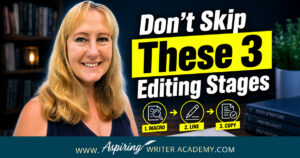
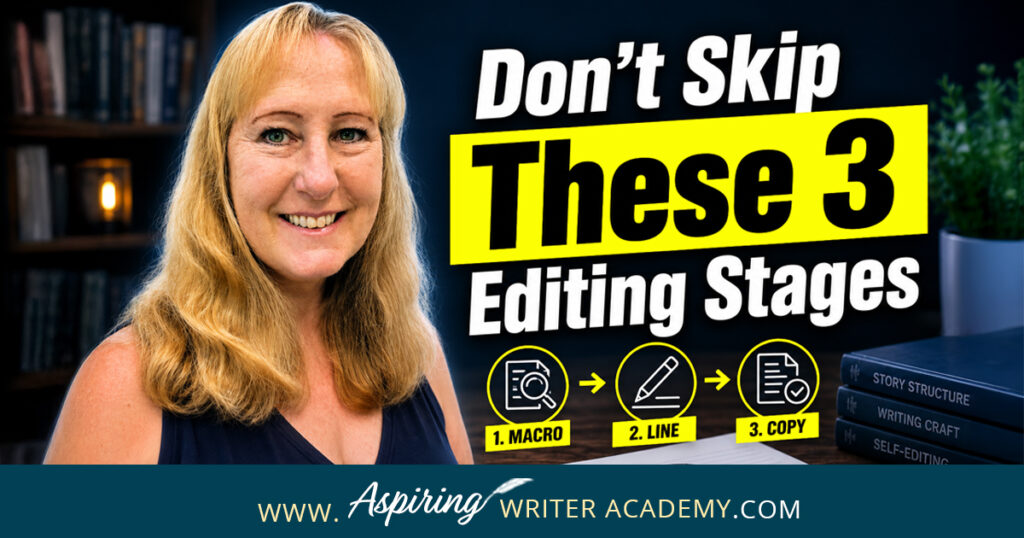
The most effective editing process happens in three distinct stages:
- Macro Edits (Story Revisions)
- Line Edits (Scene & Sentence Improvements)
- Copy Edits (Proofreading & Final Polish)
Let's look at each stage in more detail.

Stage 1: Macro Edits (Story Revisions)
This is the stage many writers try to skip—but it's arguably the most important.
Macro editing focuses on the big picture of your novel. Instead of worrying about individual sentences, you're evaluating whether the story itself works.
Think like a reader instead of a writer.
Ask yourself:
- Does my story have a strong beginning, middle, and ending?
- Does the opening hook readers quickly?
- Is the inciting incident introduced early enough?
- Does the pacing stay engaging throughout the novel?
- Are there scenes that drag?
- Are there unnecessary characters?
- Does every chapter move the story forward?
- Is my protagonist changing throughout the story?
- Does the climax resolve the central conflict?
- Are all major subplots resolved?
This is also the time to move scenes, delete chapters, rewrite major sections, strengthen character arcs, and improve your overall story structure.
Don't worry about grammar yet.
If an entire chapter eventually gets deleted, every minute spent polishing that chapter was wasted.
Give Yourself Time Before Editing
One of the best things you can do after finishing your manuscript is…
Walk away.
Give yourself a few weeks away from your story before beginning revisions.
Distance allows you to come back with fresh eyes and notice problems you couldn't see while writing.
Stage 2: Line Edits (Micro Edits)
Once your story is structurally sound, it's time to zoom in.
Line editing focuses on improving the reading experience sentence by sentence.
Instead of asking:
"Does this chapter belong?"
You're asking:
"Can I make this paragraph stronger?"
During line edits you should:
- Strengthen sentence structure
- Improve dialogue
- Remove unnecessary dialogue tags
- Replace weak verbs
- Cut excessive adverbs
- Eliminate passive voice
- Remove repetitive words
- Improve scene transitions
- Balance dialogue, description, and action
- Strengthen emotional impact
- Check point of view consistency
- Improve scene endings
- Show instead of tell whenever appropriate
This is where your writing style begins to shine.
Strong line editing doesn't simply remove words—it makes every sentence work harder.
Ask Yourself While Line Editing
As you review each scene, consider questions like:
- Does this scene have a purpose?
- Does every paragraph move the story forward?
- Are the character's actions believable?
- Are readers grounded in the setting?
- Is there enough conflict?
- Is the pacing balanced?
- Are my transitions smooth?
- Am I engaging all five senses?
These smaller improvements add up to a dramatically stronger manuscript.
Stage 3: Copy Edits (Proofreading)
Only after your story and prose are complete should you begin proofreading.
This final editing stage is about polishing.
Here you're looking for:
- Grammar mistakes
- Misspelled words
- Missing punctuation
- Formatting inconsistencies
- Incorrect capitalization
- Repeated words
- Character name inconsistencies
- Timeline errors
- Continuity mistakes
- Minor typos
At this point, you shouldn't be rewriting scenes or deleting chapters.
You're simply making an already strong manuscript publication-ready.
Why Editing in the Wrong Order Wastes Time
Imagine spending three hours polishing Chapter Five...
Only to realize during revisions that Chapter Five needs to be deleted entirely.
That's why experienced authors almost always work from the largest problems to the smallest.
Think of editing like building a house.
You wouldn't paint the walls before pouring the foundation.
The same principle applies to writing.
Build the story first.
Perfect the sentences second.
Polish the grammar last.
A Simple Editing Checklist
 Step 1 — Macro Edits
- Story structure
- Plot
- Character arcs
- Pacing
- Scene order
- Conflict
- Theme
Step 2 — Line Edits
- Dialogue
- Word choice
- Sentence flow
- Showing vs. telling
- Strong verbs
- Scene transitions
- Point of view
Step 3 — Copy Edits
- Grammar
- Spelling
- Punctuation
- Formatting
- Consistency
- Final proofread
Final Thoughts
Every author—whether you're writing your first novel or your fifteenth—can improve through thoughtful revision.
Editing isn't about making your writing perfect on the first pass. It's about knowing what to focus on at each stage so your time and energy are spent where they'll have the greatest impact.
When you follow the right editing order, you'll strengthen your story, improve your prose, and produce a manuscript that's ready for readers.
We Believe All Authors Can Aspire to Take Their Writing to the Next Level!
Our Goal for Aspiring Writer Academy is to help people learn how to write quality fiction, teach them to publish and promote their work, and to give them the necessary tools to pursue a writing career.
Before You Go… Grab This Free Resource!
If you’re in the early stages of writing your novel, don’t forget to download our free Brainstorming Your Story Idea Worksheet. It includes:
-
Fill-in-the-blank prompts
-
Story structure examples
-
Guided questions
-
Idea-boosting templates
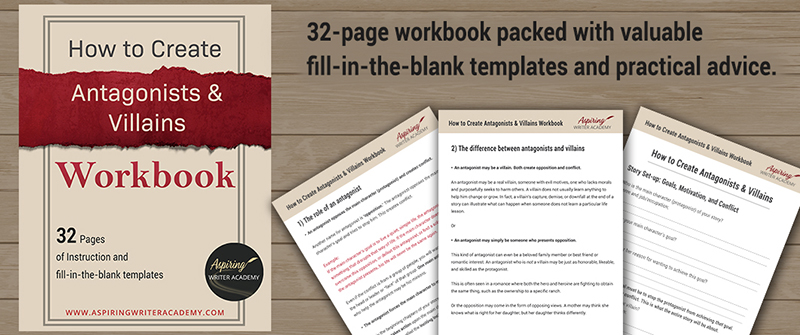
Do you find it difficult to create compelling antagonists and villains for your stories? Do your villains feel cartoonish and unbelievable? Do they lack motivation or a specific game plan? Discover the secrets to crafting villains that will stick with your readers long after they finish your story, with our How to Create Antagonists & Villains Workbook.
This 32-page instructional workbook is packed with valuable fill-in-the-blank templates and practical advice to help you create memorable and effective antagonists and villains. Whether you're a seasoned writer or just starting out, this workbook will take your writing to the next level.
Other Posts You May Like: